If you are looking for the best alternative to Zapier, then watch this. Because this can be the most important message you read today.
Zapier was built to join apps without code, and it still does that well. But there is a catch. Zapier bills you per task, and every step in a flow spends a task. When AI runs your work, it takes many steps. So the bill can grow really fast.
Picture this. A flow that ran for six months stops on a Tuesday. You changed nothing. An app moved its API. A login expired overnight. Now the job is on you again. Not because Zapier is bad, but because keeping the flow alive became the real work.
This guide shows you 7 Zapier alternatives and who each one is for. Six of them still make you build a flow. The real question is simple: do you want a better builder, or do you want to stop building altogether?
Zapier is not slowing down. It has grown into one of the biggest automation tools, with 9,000+ apps. Yet people keep searching for a way out. Usually for one reason: the meter. The task count runs up, and the price follows it.
In 8 short sections, you will see your choices. Best of all, you will find the one that fits how you work.
Why people are leaving Zapier in 2026
People came to Zapier for the same reasons: no code, 9,000+ apps, and a free plan. It is easy to start. Then they run real work through it, and the task count tells a different story.
Zapier bills per task. One step equals one task. A flow with five steps costs five tasks each time it runs. MCP calls cost two tasks each. So the busier your work gets, the more the same flow costs.
Then AI arrives. An agent does not run once and stop. It checks a source, retries a step, drafts, and tries again. On a per-task meter, all that effort is billable. You are charged for how hard it worked.
There is a second cost, too. Every flow needs care. Steps break. Logins expire. Apps change. If you own the flow, you own the fixing. Many people wanted the work done, not a new chore.
And lastly, people discovered they do not need these 9,000 apps integration while all they need is just a few apps they are using to run their workflows.
That is why the search keeps growing. Some people want a cheaper meter. Some want open source. Some want to stop building flows at all. This guide covers all three.
First, here is how we compared the tools, so you don’t trade one problem for another.
How we compared these 7 tools
Every tool below is tested with the same six questions. The first three are about fit: can you run it, what does it cost, and who runs it day to day. The last three are about limits: does it work unattended, does it know your apps, and what does switching cost. We compare the result, not just the feature list.
Here are the questions we used:
- Can you run it yourself?Can you host it on your own computer? Does the license allow what you plan to do? Can your data stay where the law says it must?
- What does it really cost?We run the same job through every price meter. Then we show which ones keep charging you once AI gets involved.
- Who runs it day to day?For each tool we name who keeps it alive after setup. You, an engineer, a team, or a founder. Then we show what that upkeep really takes.
- Does it work while you sleep?Four things decide this. Does it run on its own? Does it remember between runs? Does it act without asking you at every step? Can you steer it when it goes wrong?
- Does it know your apps?You will see how deep the app connections go. You will also see where you might hit a wall and have to build your own way out.
- Is it easy to switch?No tool here can import your Zaps. You rebuild them by hand. The good news: most teams finish in days, not weeks.
The whole field in one simple screen
This table is the shortcut: all seven alternatives on one screen, so you can see the field before reading a single full review. If you came in with one constraint, this is where you find which tools meet it.
Each row is one tool. Each column answers one question: where it runs, how many apps it has, how serious its AI is, and what it does with your data. The table stays short on purpose. The details live in the profiles below.
If you want more detail to find the best tool for you, keep reading.
| Tool | Hosting | Integrations | AI use | Data |
|---|---|---|---|---|
| Zaira |
| 100+ | A powerful agent. You give it a goal. It plans the steps, picks the tools, and runs them on its own. | You own your data. Never used to train AI. |
| Make |
| 3,000+ | An AI agent can build a flow from text. Every step spends credits. | Turn on “confidential” mode to hide all data. |
| n8n |
| 1,000+ | An AI Agent node plus MCP tools. You host and run the loop. | Data is yours. Never used to train AI. |
| Activepieces |
| 764 | AI agents across 764 pieces. Each piece also works as an MCP server. | Self-host for full control. SOC 2 on the cloud. |
| Pipedream |
| 3,000+ | MCP servers let your own AI agent use 3,000+ apps. | SOC 2 and HIPAA. You own your code. |
| IFTTT |
| 1,000+ | Simple applets with basic AI steps. Not built for agents. | Data is handled under its privacy policy. |
| Power Automate |
| 1,400+ | Copilot drafts flows. AI Builder reads documents. Copilot Studio runs agents on a separate license. | Microsoft won’t use your data unless you say yes. |
The 7 alternatives, one by one
Below are the seven alternatives we reviewed, each through the same lenses: what it is best at, how it handles work, its pros and cons, and the reason you would switch. None are the same. Some replace Zapier’s canvas. Some replace the meter. One replaces the idea of building a flow at all.
Every card has the same shape, so the tools compare side by side. Start from the reason you searched and jump to that card, or read them in order.
Zaira
An agent, not a builder. You give it a goal. It works out the steps and gets the job done.
Six of the seven tools here make you build a flow. You pick a trigger, then add steps. Zaira works the other way. You tell it the result you want. It finds the steps, picks the tools, and runs the job across your apps. It keeps going after you close your laptop. It also remembers what it learned, so week eight works better than week one. Web search, image and video generation, and scheduled runs come built in.
Connect your tools once, like Gmail, Slack, Stripe, and HubSpot. Then tell Zaira the result you want. It makes a plan, pulls live data, and does the job. It runs on a schedule or when something happens. It keeps memory between runs, so you don’t repeat yourself. Big jobs get split between helpers that work at the same time. Results land in Slack, Telegram, or Discord. You check the result, not the wiring. There is no canvas to build and no server to keep alive.
Pros:
- You give it a goal, it gets the work done
- Runs on its own, on a schedule or a trigger
- Remembers things between runs
- Keeps working after you close your laptop
- Reports back in Slack, Telegram, or Discord
- No canvas to build or fix
- No server to run or patch
- Handles app and API changes for you
- Splits big jobs across helpers that run at once
- Web search, AI image, and AI video generations built in
- 40+ AI models across 8 providers
- Flat price that does not charge you extra without your consent
Cons:
- Cloud only.
- 100+ core apps built in
Make
The hosted canvas that is easy to learn
Make is a visual automation tool that runs in the cloud. You drag blocks onto a canvas to build a scenario. It connects 3,000+ apps, and there is nothing to host or patch. It is a good pick for marketing, ops, and finance teams that want to see and edit their work.
You drag modules onto a canvas. A trigger starts the flow, then actions run across 3,000+ apps. Routers and filters let you branch. Scenarios run on a schedule or when triggered. You pay per operation, so every module spends part of your monthly quota, and long flows use it up faster.
Pros:
- 3,000+ apps with a clean drag-and-drop canvas
- Cloud hosted, so there are no servers to patch
- HTTP and custom code steps when the catalog ends
Cons:
- Still a builder. You maintain every scenario
- No image or video generation built in
- Per-operation pricing climbs as you scale
- Your data may train Make’s AI unless you turn on confidential mode
- Takes weeks to learn the tricky parts
n8n
The power pick for technical teams
n8n is a workflow builder that leans technical. You can host it yourself for free, or use its cloud. It has 1,000+ nodes and lets you write code inside a flow. It is the pick for engineers who want deep control.
You connect nodes on a canvas. A trigger starts the flow, and nodes pass data along the way. Some nodes run your own JavaScript or Python. Self-hosted, runs are free but you pay with your time. On the cloud, you pay per run, and agent or AI nodes use runs fast.
Pros:
- Self-host for free with full control
- 1,000+ nodes and code inside flows
- Deep control for technical teams
Cons:
- You patch, host, and scale the server
- Not truly open source (fair-code license)
- Loops and AI nodes burn extra runs
- Steep learning curve
- Still a builder. You maintain every flow
Activepieces
The open-source pick with no run limits
Activepieces is an open-source workflow builder. It uses the MIT license, so you can fork it and host it yourself. You can run unlimited flows without paying per run. It is the pick for teams that put the license first.
You build flows on a canvas using 764+ pieces. Each piece also works as an MCP server for your own agent, and custom code steps cover the gaps. Self-hosted, flows run without a limit. On the cloud, you pay per active flow, not per run, so a flow that fires 10,000 times costs the same as one that fires once.
Pros:
- MIT license, so it is truly open source
- Pay per active flow, with unlimited runs
- Each piece works as an MCP server
Cons:
- Smaller app list than n8n
- You build and maintain every flow
- No image or video generation built in
- Takes a few weeks to learn the canvas
Pipedream
The code-first tool for developers
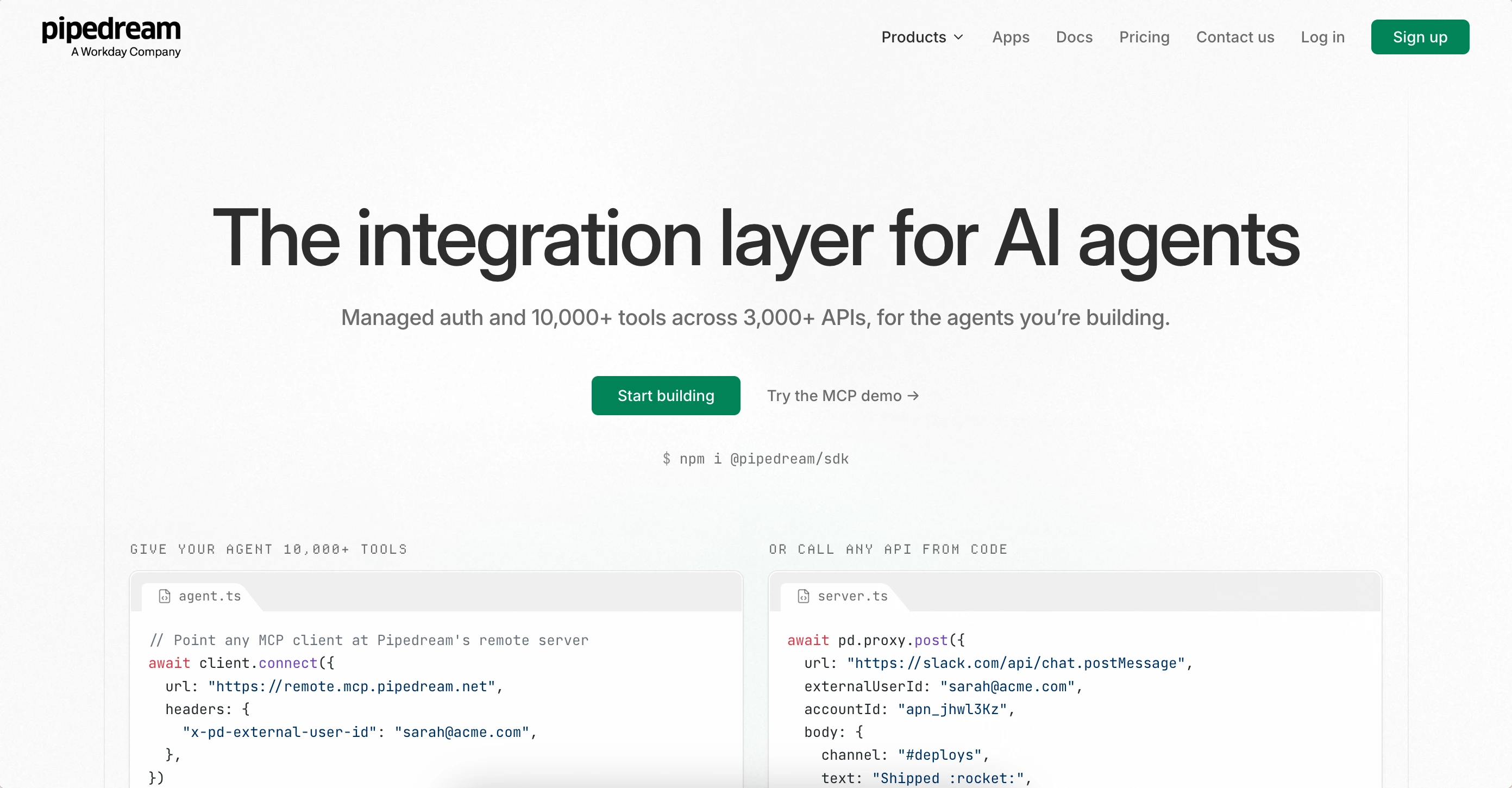
Pipedream is a serverless tool built for developers. You write flows as code, not as boxes. It runs Node.js, Python, Go, or Bash steps. It is the pick for teams that want API-level control and apps they can embed in their own product.
You build flows in code. A trigger starts them, then steps run in Node.js, Python, Go, or Bash. It has managed login for 3,000+ apps, and you can ship the same integrations as MCP servers. Usage runs down a monthly credit.
Pros:
- 3,000+ apps with managed login
- Code control in Node, Python, Go, and Bash
- MCP servers and an SDK for embedding
Cons:
- Source-available license, not open source
- Cloud only, with no self-host
- Credits run out as flows grow
- No image or video generation built in
- Steep curve. Everything is code
IFTTT
The simple pick for personal tasks
IFTTT is the simple choice. It connects apps with short rules called applets. It is easy for anyone to use, and it is cheap. It is best for personal tasks, not for busy business flows.
You pick an app and a trigger, then an app and an action. If this happens, do that. That is an applet. IFTTT is great for simple jobs like saving a photo or posting to social. It is not built for long, multi-step business work.
Pros:
- Very easy to set up
- Low price
- Good for simple personal applets
Cons:
- Not built for multi-step business work
- Little control over the steps
- No agent that plans its own steps
- No image or video generation built in
Microsoft Power Automate
The obvious pick only inside Microsoft
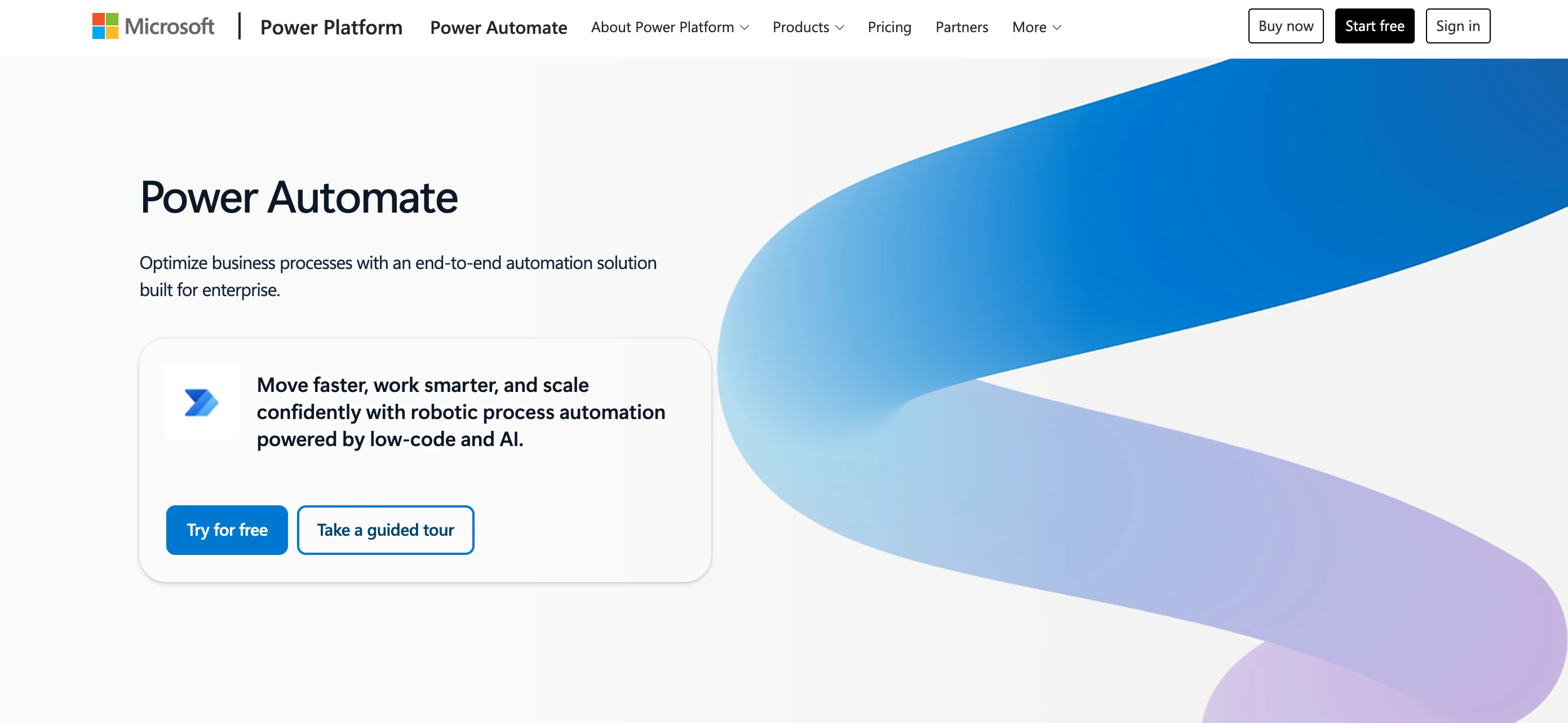
Power Automate is Microsoft’s automation tool. It works well with Office 365, Dynamics, and Azure. It has built-in sign-on and company controls. It is the clear pick for firms already living inside Microsoft.
Inside Microsoft 365 you build flows in a visual editor. They connect Outlook, SharePoint, Teams, and Excel, plus 1,400+ apps. Copilot can draft flows, and AI Builder can read documents. You pay per user, and robot licenses cost extra.
Pros:
- Works natively with Office 365, Dynamics, and Azure
- Built-in sign-on and company controls
- PowerShell and HTTP actions for the gaps
Cons:
- Clunky outside Microsoft apps
- Expensive at scale
- No web search or image generation by default
- Takes time to learn outside Microsoft 365
What each tool costs when you run a lot
This section shows what each tool charges to start, and more important, what it charges when you run past your limit. That overage is the cost most people miss. It is also where a bill can quietly run away.
Scan the overage column and the field splits in two. The flat plans end at $0. Everyone else rents you a meter. That empty cell is the whole difference between a bill you can guess in week one and one that surprises you every month.
An agent costs more to run than a simple flow. It retries a step, checks a second source, drafts, and revises. On a metered plan, you pay for all of that. That is the real problem with metering an agent: you are billed for its care.
A flat plan is not cheaper because the math is neater. It is cheaper because the number stops moving as the agent gets stronger. If your tool bills per task, per operation, or per credit, expect the bill to rise the day the automation starts working well.
| Tool | Starting price | Overage charge |
|---|---|---|
| Zapier | $20/mo | $0.016 / task |
| Zaira | $19/mo | $0 |
| Make | $12/mo | $1.50 / 1K credits |
| n8n | €20/mo | €13.3 / 1K runs |
| Activepieces | $5/active flow | $0.007 / credit |
| Pipedream | $29/mo | $0.0145 / credit |
| IFTTT | $3.99/mo | $0 |
| Power Automate | $15/user/mo | $0.60 / run |
So, which one is right for you?
The best pick comes down to your situation and how much time you want to spend on setup. Use the guide below to see which tool fits you.
If you want work to happen while you sleep, you don’t want a faster builder. You want something you can hand work to and then go to bed. That is a different product, not a better Zapier. Zaira runs on a schedule or a trigger, remembers between runs, and sends results to Slack or Telegram. You check the output in the morning. We recommend starting with Zaira.
If you are a founder or ops lead, you came to Zapier to save time and ended up fixing it at night. You want the work done: follow-ups sent, CRM updated, reports delivered. Not a second job. We recommend starting with Zaira. Connect your tools, name the job, and it runs on its own.
If you are non-technical, you need flows that anyone can read and tweak. Zapier’s task pricing can still surprise you at volume. Start with Make for a visual canvas you can see and edit, or Zaira if you don’t want a canvas at all.
If you want an open-source and self-host option, so your data stays on your servers and the license is truly open. Start with Activepieces for a visual builder, or n8n if you want deep nodes and can run a server. This is the path for engineers.
Still on the fence? See how people choose here:
| Situation | The Recommendation | The Reason Why |
|---|---|---|
| You don’t want to build or fix flows | Zaira | Give it the goal. It plans the steps and runs them. |
| You want a canvas with nothing to host | Make | A clean drag-and-drop builder in the cloud. |
| You need deep control and can host it | n8n | 1,000+ nodes and code inside flows. |
| A real open license is the dealbreaker | Activepieces | MIT license with unlimited self-hosted runs. |
| You want full code control | Pipedream | Write flows in code, with 3,000+ apps. |
| You only need simple rules | IFTTT | Cheap, easy applets for personal tasks. |
| Your company runs on Microsoft | Power Automate | Native links to Office 365, Dynamics, and Azure. |
Frequently asked questions
What is the best Zapier alternative?
It depends on what you are leaving behind. If you want to keep building flows but own the code, Activepieces is the MIT-licensed swap. If you never wanted to run a server, Make is the hosted canvas. If you want the widest app list, Zapier already has it, and n8n gives engineers deep control. If you would rather not maintain a flow at all, Zaira takes the job off your hands. There is no single best tool, because the work is not all the same. Start with the reason you began searching.
Why do people leave Zapier?
Three reasons come up most. First, price. Zapier bills per task, so a busy flow can cost far more than a flat plan. Second, every step is a task, and each MCP call counts as two. Third, an AI agent takes many steps, so its bill grows with its effort. If you want a flat price that stays put, that is Zaira.
Is Zapier free?
Zapier has a free plan, but it is small. It gives you 100 tasks a month. Paid plans start around $20/mo. Each step in a Zap spends a task, so real work runs through them quickly.
Is there a Zapier alternative with a flat price?
Yes. Zaira Pro is a flat $19/mo with no overage. IFTTT is also flat and cheap, but it only handles simple applets. Most others, like Zapier, Make, n8n, Pipedream, and Power Automate, bill per task, per operation, or per user.
What is the best free Zapier alternative?
“Free” usually means “bring your own server.” Self-hosted n8n or Activepieces run without a run limit, for the price of a small box. On hosted plans, free tiers stay small. Make gives 1,000 operations a month, Zapier offers 100 tasks, and Zaira’s free plan runs fully in the cloud with no card needed.
Can I migrate my Zaps to another tool?
Not by import. No tool here reads Zapier’s export, so you rebuild each Zap by hand. The fastest path has four steps. Sort the Zaps that truly matter. Write each one as a plain goal. Connect your tools once. Run the new job beside the old one until the result looks right, then turn the old Zap off. Most teams finish in days rather than weeks.
Is there a Zapier alternative that needs no building?
Yes, and that is the slot Zaira fills. Every other alternative, Zapier included, asks you to build a flow: trigger, steps, filters, and error paths you then maintain. Zaira flips it. You name the goal, connect your tools, and it works out the steps and runs them. Nothing to drag, nothing to debug.
Is Make better than Zapier?
Make is often cheaper per step and easier to branch with its canvas. Zapier has more apps (9,000+ vs 3,000+) and is quicker for simple flows. Both bill by usage, so both get costly at volume. Pick by who will maintain the flow, not by the marketing.
Is n8n a good Zapier alternative?
For technical teams, yes. n8n self-hosts, ships 1,000+ nodes, and lets you write code inside a flow. It gives you the most control of anything here. The trade is upkeep: you patch, host, and scale the server. If nobody wants that job, Zaira removes the server from the picture.
How does Zaira’s price compare to Zapier’s?
Zapier starts at $20/mo and bills per task, so the bill grows as you run more. Zaira Pro is $19/mo flat with no overage. A more capable agent does not make a bigger bill. That is the main difference: one meters your work, the other does not.
What happens to the price when an agent runs on its own?
On a flat plan, nothing changes. That is the reason to pick one. On per-task billing, an agent is costly by design. It retries a failed step, checks a second source, drafts and revises. Every one of those is another billable unit you did not ask for. Zapier charges two tasks per MCP call. So compare tools by what a month of working automation costs, not by price per run.
Does anything here handle broken apps and API changes for me?
No builder does. This is how a flow dies on a Tuesday: an API moves, a step breaks on update, or a login expires. Zaira keeps its connections up to date, so app changes and outages get handled on its side instead of becoming your weekend job.
Can Zaira replace Zapier completely?
For many ops, content, and reporting jobs, yes. Keep a builder like Zapier or n8n when you need self-hosting, heavy custom code, or air-gapped setup. Hybrid stacks are common.
How fast can I switch from Zapier?
Most teams finish in days. The work is picking the Zaps that matter and writing each as a plain goal. You do not need to rebuild the wiring by hand if you use Zaira. You name the job, connect your tools, and let it run.
Sources
- Zapier plans and pricing
- Make pricing
- n8n plans and pricing
- Activepieces pricing
- Pipedream pricing
- IFTTT pricing
- Microsoft Power Automate pricing
- n8n Sustainable Use License (fair-code)
- Activepieces license (MIT)
- Pipedream repository (source-available license)
- Zapier data privacy and security
- Activepieces Trust Center (SOC 2)
- Pipedream privacy and security (SOC 2 / HIPAA)